
Tips For Sharing A Bed When You’re Not Sleep Compatible
9 Min Read |
Last Modified 17 August 2026 First Added 17 August 2026

Sharing a bed is lovely right up until about 2 am. That is usually when the duvet quietly migrates, a cold foot arrives without warning, and you find yourself doing sums about how many hours are left.
It is easy to decide that the problem is the other person. Then you remember that you snore. Or fidget, or run hot, or want the window open in February. Very few of us are completely easy to sleep next to, and there is something quite freeing in that.
So we have set this out one problem at a time. Find yours, take the fix and skip the rest. We won’t be offended.
The lowdown: Most bed sharing problems have a specific fix, and sleeping apart is the last one on the list rather than the first. Two duvets solve duvet theft. A bigger bed with the right mattress solves fidgeting. Staggered bedtimes solve mismatched body clocks. Small changes, better nights.
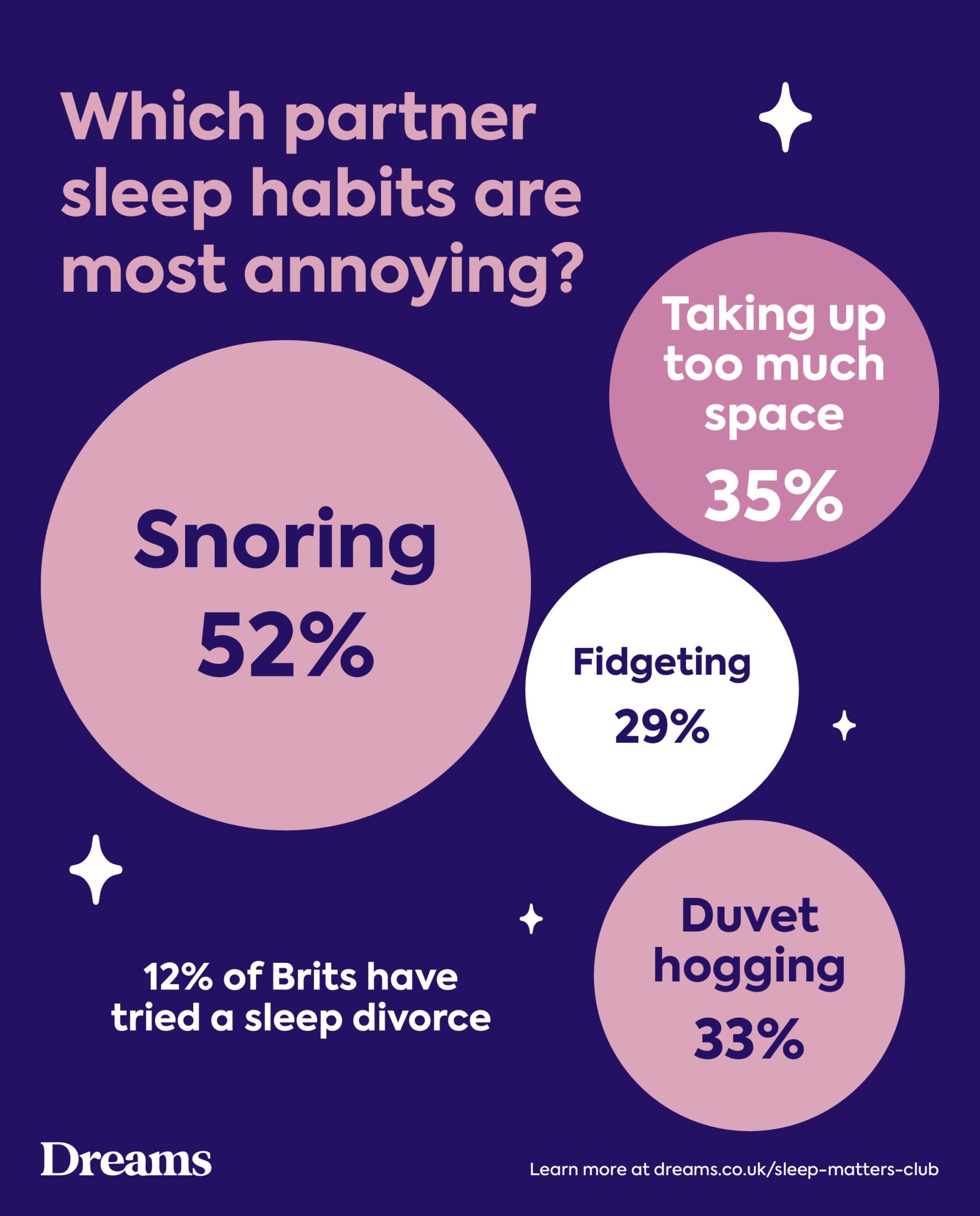
We asked 2,000 people in our 2026 Dreams Sleep Survey what they find annoying about sharing a bed. Among everyone who shares or has shared one, the answers came out like this:
Only 16% said nothing about it bothers them at all. Which means roughly five in six of us have a complaint, and most of us have several.
A quarter of people said they sleep better when their partner is not there. Around one in five said they never go to bed at the same time as their partner. And 11% currently sleep in separate beds or separate rooms.
So if your bed feels like a nightly negotiation, that is the normal state of affairs rather than a sign that something has gone wrong.
Here is the strange bit. The research points in two ways at once. Ask people how they slept, and most say they sleep better next to their partner. Measure them while they do it, and the machines say they moved more and woke more. Both are true at the same time. A review of research on couples and sleep describes exactly this pattern.
One small lab study went further. Researchers monitored young couples sleeping together and then sleeping alone. Sharing a bed was linked to more REM sleep and steadier REM sleep, even though the couples moved around more. It was a small group of young, healthy couples, so treat it as a clue rather than a conclusion.
What that adds up to is a good reason to fix the bed before you consider something as drastic as a sleep divorce. The company might be doing you more good than the elbows are doing you harm. Below, we started with the easiest fixes and worked our way up, so the further down you go, the bigger the change.
Get two duvets. That is the whole tip.
It is known as the Scandinavian sleep method, which makes it sound far more exotic than “buy another duvet”, and it removes the problem completely because there is nothing left to fight over. You each get your own tog too, which quietly solves the temperature argument at the same time.
Only 6% of people in our survey have tried it, though 11% said they would, which puts it third on the list of sleep trends we are most curious about, behind the military sleep method and the sleepy girl mocktail. We have gone into it properly in our guide to whether couples sleep better with separate bedding.
Going up a bed size is one of the most effective changes a couple can make, and it tends to be the one people put off the longest because of the room measurements. A king size bed is 15 cm wider and 10 cm longer than a double, and a super king adds another 30 cm of width on top of that. Our mattress size guide has the full dimensions and the clearance you need around each one. Measure the room before you fall in love with anything.
If the room genuinely cannot take a bigger bed, an ottoman bed at least saves you some storage space.
This is a mattress problem more than a person problem, and it is the one where the right purchase genuinely fixes it. What you are looking for is motion isolation, which is a mattress’s ability to absorb movement on one side without passing it across to the other. Memory foam mattresses are the strongest performers here because they absorb movement rather than transmit it. Pocket sprung mattresses come a close second because each spring is wrapped and works on its own instead of moving as one connected unit.
The old trick for testing this in a showroom still works. Put something on one side of the mattress, press down firmly on the other, and see whether it moves. If you want the version with actual data behind it, our in-store Sleepmatch tool measures both of you and recommends accordingly.
In a study at the Mayo Clinic, ten couples were monitored overnight while the snoring partner was treated for sleep apnoea partway through the night. Their partners’ sleep efficiency went from 74% to 87%, and the number of times they were roused dropped by almost half. Ten couples is a small study, so treat the numbers as indicative. The direction of travel is not in much doubt, though.
Earplugs and side sleeping are worth trying, and we have collected the rest in our guides to preventing snoring naturally and stopping your partner from snoring.
When snoring is a GP conversation: The NHS advises seeing a GP if breathing stops and starts during sleep, if there is gasping or choking, or if there is heavy daytime sleepiness. Those can be signs of sleep apnoea, which is treatable and worth catching.
In our Sleep Survey, 23% of people named their partner’s body heat as an annoyance. If this sounds relatable, try two duvets with different togs, which is the same fix as the duvet hogging one, so it earns its keep twice. Beyond that, a cooling mattress and breathable cooling bedding take heat away from the hotter sleeper without making the colder one miserable. Our duvet buying guide covers which tog suits which person.
We have written a full couples’ guide to sleeping at different temperatures if this is your main battleground.
Around one in five people who share a bed say they never go to bed at the same time as their partner. Separately, 13% say they deliberately go to bed at a different time so they both get to sleep more easily. If one of you is a natural early riser and the other comes alive at 10 pm, forcing a shared bedtime means one of you lies awake resenting the ceiling. Going up separately and letting the earlier sleeper get properly under before the other arrives works better than pretending you have the same body clock.
Two things make the later arrival less disruptive. Get everything you need out of the bedroom before the first person goes up, so there is no rummaging. An adjustable bed with independently controlled sides means the night owl can sit up and read without tipping the whole mattress.
White noise is frequently recommended for this. However, a systematic review of 38 studies concluded that the quality of evidence for continuous noise improving sleep is very low, and some studies found that it made sleep worse. The reviewers said more research was needed before it could be recommended as widely as it currently is.
That does not mean throw the machine out. Plenty of people find it helps, and if you are one of them, carry on. It does mean not to expect it to fix a genuine snoring problem, and to keep the volume down. If you want to try it properly, our guide to white, pink and brown noise covers the differences.
Earplugs have the advantage of reducing sound rather than adding to it. And if you wake at everything regardless, our piece on whether you can stop being a light sleeper is a better starting point than any device.
If nothing on our list has worked, sleeping apart is a perfectly good answer, and it does not have to mean anything is wrong. 12% of people in our survey have tried a sleep divorce at some point, and another 9% would consider one. Some go back to sharing afterwards, which is why the number who sleep apart right now is a little lower, at 11%. It is more common than most people realise.
It does not have to be permanent or total. Plenty of couples do it only on work nights, when one of them has a cold, or during a bad patch of shift work. Our guide to whether it is time for a sleep divorce covers how to raise it with your partner.
Not everyone has a spare room going spare. A day bed earns its keep as a sofa in the daytime and a proper bed at night, and a guest bed folds away again in the morning. Either way, you get a real night’s sleep instead of a sofa and a blanket.

Not sure which of you is the problem? Our Bed Chemistry Tool is a quick quiz that works out how sleep compatible you and your partner really are. Best done separately, then compared. Bring snacks.