Born from NASA technology and perfected for sleep.
Relationships
5 min read
Sleep Science
8 min read
Whether you’d consider yourself a sleep prodigy or night-time novice, we know catching Zzzs isn’t always easy. Try our handy Sleep Health Calculator, with 12 simple questions to measure your bedtime choices and sleep quality. We’ll share expert advice based on your results to help you drift off to the land of nod.
Congratulations, you sleep guru! Looks like you’ve mastered the art of slumber and won’t be needing our help. But if you’d like to further improve upon your sleep quality, read on for some additional advice from our sleep experts!
Turns out you sleep pretty well, but it could be better. Consider making small changes to your daily routine to catch those extra zzz’s. For example, take a look at how many hours of sleep you get, your caffeine intake and the comfort of your bed to achieve a perfect night’s sleep. Read on for some simple solutions from our sleep experts.
Yikes! Your sleep health is significantly suffering and it’s a mystery how you’re still able to function. Whether this low score is due to stress, caffeine, technology or your bed, read on for our simple solutions from our sleep experts to help you get a much needed good night’s sleep!
What to work on
Although you’ve probably heard it many times before, the Sleep Health Foundation recommends getting between 7 and 9 hours of sleep a night if you’re an adult, roughly 8-10 hours for teenagers and around 9-11 hours for children. This allows your body to recover from the day’s activities and restore your energy for the next morning.
There are a small percentage of adults known as ‘short sleepers’ who can survive on 6 hours of sleep or less and do not feel the effects of sleep deprivation, however too little sleep comes with some alarming side effects. For example, sleep deprivation has often been linked to obesity, heart disease and diabetes, not to mention a drowsy day at work.
Even though it’s difficult to set aside extra time for sleep, especially with a busy schedule, try to put sleep higher up on your priorities and schedule roughly 8 hours every night.
You might find this really useful: www.dreams.co.uk/sleep-matters-club/what-happens-to-your-body-during-8-hours-of-sleep-2
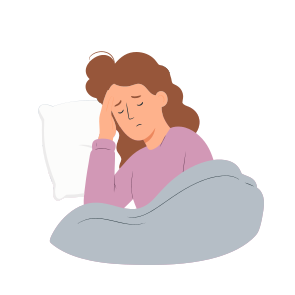
Roll over. It’s 3 am. Groan. Sound familiar? Waking up in the night is a sign that your sleep might be suffering, so it’s worth paying attention to. How often you wake gives an idea of your sleep quality, which is just as important as sleep quantity (in other words, how many hours you sleep).
If you’re up a lot during the night, you’re not alone. Our 2026 Sleep Survey found that Brits experience disturbed, broken, or poor sleep about half the time – an average of 3.40 nights each week. The most common reasons given for sleep disruption were racing thoughts (37%), stress (28%) and being too hot (24%). Thankfully, most of these things can be managed by a few lifestyle changes, such as a cooling mattress and bedding and a relaxing wind-down routine.
Here’s a little more advice on how to get back to sleep quickly if you find yourself awake in the early hours. If you need mental health support for racing thoughts or stress, we also have advice from our charity partner, Mind.
How many times did you hit snooze this morning? Don’t worry, we won’t tell. But if you’re often sleeping through your alarm, it could be a sign that you’re not feeling refreshed come morning.
It’s normal for your body to take a few minutes to wake up. We can’t all bounce out of bed first thing! But if you’re consistently feeling groggy when you wake and throughout the day, that might need further investigation. One possible cause is that you’re waking up during deep sleep, a crucial stage of your sleep cycle where you’re harder to rouse. Waking up at the end of a cycle instead, during light NREM sleep, is much easier on your body and doesn’t cause that pesky grogginess.
To make sure your alarm never catches you out, our handy Sleep Cycle Calculator can work out the perfect bedtime and wake time for you, optimising your natural sleep cycles and helping you feel refreshed.
While, for most of us, caffeine may seem like an essential part of your day, it can prohibit a good night’s sleep and could be what’s keeping you up at night.
It’s recommended to avoid all caffeinated products, whether that be coffee, tea, hot chocolate, or caffeinated soft drinks for roughly six hours before you hit the sheets. This is because, once in the body, only one half of your caffeine intake is eliminated after 6 hours. So if you plan to go to bed at around 11pm, have your last brew before 5 and say no to the nightcap.
It’s also important to note that while caffeine is useful for making you feel more alert and blocking the sleep-inducing chemicals in your brain, it cannot and should not replace sleep. So make sure you still pencil in the recommended eight hours.
Here’s a little more info on caffeine before bed.
As another nightcap that we regularly indulge in, alcohol surprisingly prohibits sleep. Although it induces a drowsy effect which actually allows you to fall asleep quicker, even a couple of drinks increase the chance of waking up during the night.
This is because alcohol reduces REM sleep, which is the stage of sleep involved with deep dreaming. These disruptions in REM sleep can often result in daytime drowsiness. This, combined with a hangover, isn’t going to lead to much productivity.
A tip for resolving this, is to avoid alcohol before bed as it takes roughly an hour for a unit of alcohol to be processed. That’s roughly a half pint of beer and just less than a small glass of wine. So try and have your last beverage during dinner.
If you’re still after a night cap, opt for a herbal tea which can be a natural sedative. You might also find this article handy: www.dreams.co.uk/sleep-matters-club/the-science-behind-why-alcohol-is-bad-before-bed
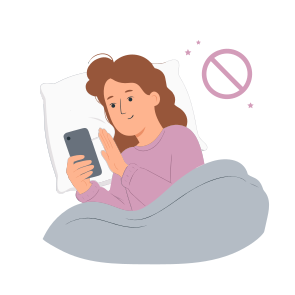
In this day and age, tech free time seems almost impossible and around 78% of people use a smartphone, tablet or laptop before going to bed. As comfortable as it is to watch television or browse the internet in bed, this can unfortunately result in poor sleep. This is because phones, television, laptops and tablets emit blue light and exposure to this blue light results in a delay of melatonin production, which is the sleep-inducing hormone.
To solve this, give yourself a tech curfew and try to avoid using technology for roughly 2 hours before you go to bed. During this time, you could read, write, meditate, or even play a game with your partner or family. If you want to take it a step further, it’s beneficial to keep technology out of the bedroom while you sleep, just in case your phone goes off during the night.
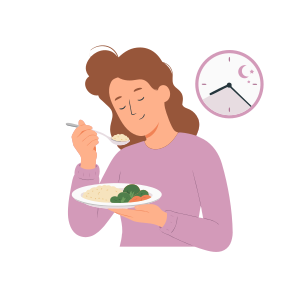
Even though it’s convenient on a super busy day, having a late dinner could be the cause of your sleep problems. Studies have shown that eating certain foods before bed can negatively impact your sleep quality and even increase the chances of heart burn.
Sammy Margo, author of the Good Sleep Guide says ‘if you plan to eat a heavy meal, you need a good few hours for it to digest.’ So we recommend leaving it roughly 3-4 hours to let the food clear the stomach.
If, however, you’re still feeling peckish before bed, we recommend snacking on foods which contain tryptophan. For example, yogurt, milk, bananas, eggs and turkey are all high in tryptophan. This helps the body produce serotonin, which in turn makes melatonin, the sleep-inducing hormone.
Find out some great midnight snack ideas.
Stress is a huge factor in keeping people awake at night and many of us toss and turn due to anxiety. Unfortunately, chronic stress results in less sleep, which in turn releases more stress hormones, so it’s a difficult cycle to break.
As much as we’d like to avoid it, feeling stressed at some point is inevitable. While we can’t get rid of stress completely, there are some measures you can take to ease it. For example, to relieve stress Dr Susan Biali recommends exercising more often. This releases endorphins and triggers a positive feeling in your body. You could also try to avoid having too many coffees throughout the day, as caffeine is a stimulant often associated with anxiety.
Other immediate solutions to ease stress during bedtime include deep breathing, meditation and yoga techniques to help you relax.
Here are some more tips you might find useful: www.dreams.co.uk/sleep-matters-club/reduce-anxiety-better-nights-sleep
Here’s also an article to demonstrate some helpful yoga positions.
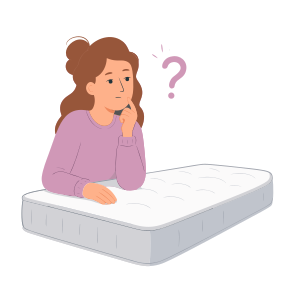
An old mattress could be the culprit if you’re suffering from sleepless nights. Aged mattresses eventually lose their support, which often leads to soreness, aches and back pain, consequently keeping you up overnight. Not only this, but an old mattress is an ideal breeding ground for bacteria, mould, bed bugs otherwise known as Cimex Lectularius and dust mites. For example, up to a terrifying 10 million dust mites can gather in an old mattress to feed on dead skin cells.
To avoid this fearful fate, we recommend replacing your mattress every 8 years. This can help you keep good mattress hygiene and avoid the structure sagging and dipping, so your pressure points can remain consistently supported and you can get a good night’s sleep.
We also recommend turning and rotating your mattress throughout its lifespan to regularly air it out to maintain its comfort and hygiene for those 8 years.
Here’s some further info: www.dreams.co.uk/sleep-matters-club/what-happens-to-your-mattress-over-time-survey
The state of your sheets and your sleep environment can also play a huge role in your sleep quality and not changing your bedding regularly enough can contribute to health problems such as allergies or asthma. Because of the dead skin cells that you shed every night, sleeping in unwashed sheets can attract dust mites that feed off of the cells and result in infections or worsened breathing for asthmatic people.
Shockingly enough, in a recent study, one in ten adults confessed to only washing their bedding once a month! However, microbiologist Laura Bowater recommends washing sheets once a week at a minimum of 60 degrees to kill all the bacteria.
Aside from the potential germs, washing your bedding helps you obtain greater peace of mind. A study by the National Sleep Foundation confirms that people sleep much better when their bedrooms are comfortable and clean.
Learn more about the bacteria that live in your mattress.
Bedroom Environment
6 min read
Health & Well-Being
Problems Sleeping
7 min read