
How to Fluff a Pillow
9 Min Read |
Last Modified 21 August 2026 First Added 2 June 2021

There is a particular disappointment in a flat pillow. You fold it in half, you wiggle around a bit, you turn it over, hoping the other side has been keeping something in reserve. It has not.
Most pillows have more life in them than that, and getting it back takes a couple of minutes. The trick is matching the method to what is actually inside, because the thing that revives a feather pillow will quietly ruin a memory foam one.
Quick rule: If the filling can move, you can usually redistribute it by hand. If it’s a solid block of foam, don’t bend, fold or try to reshape it. Always follow the manufacturer’s care label.
The lowdown: Fluff a feather, down or hollowfibre pillow by hand, in the tumble dryer with a tennis ball, or by hanging it on the line. Solid memory foam is the exception and wants leaving alone. Check the care label first, and if a pillow is flat again by morning, it has done its time.
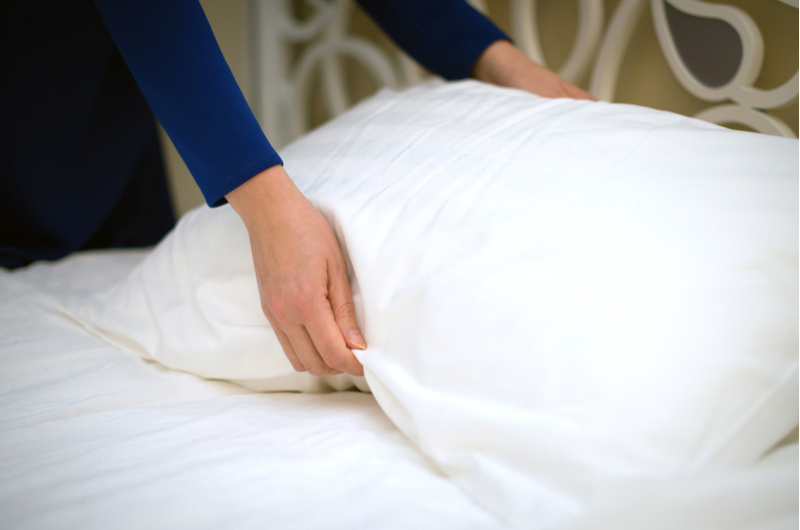
This is the quickest method, and you can do it while the kettle boils. It works on any pillow with a loose, movable filling, such as feather, down, hollowfibre, wool, or shredded memory foam.
No pillows were harmed in the writing of this article, though a few were spoken to firmly.
This one is easier on the arms, and it does a better job of redistributing filling that has settled into one end.
Check the care label first, because not every pillow can be tumble-dried. If yours can, set the dryer to a low heat and put the pillow in with a clean tennis ball. If the ball has seen better days, drop it in a sock and knot the end. Twenty minutes is usually enough. The ball knocks around inside and breaks up the clumps as it goes.
Two dryer balls do the same job if you have them, and they do it more quietly. Two fillings to watch before you load the drum, though. Solid memory foam should not go anywhere near a hot dryer, and wool should be kept on low heat. Both are covered below.
On a decent day, the washing line does the work for you.
Pillows lose height partly because of moisture. You sweat into them every night, and the filling holds onto it. A few hours outside dries the fibres out and lets them spring back, and moving air through the pillow takes odours with it.
Hang it on the line or lay it over a clothes airer somewhere sunny, and give it a shake and a turn halfway through.
So which one is yours? It is worth knowing, because one of these fillings needs a completely different approach:
Feather and down
The easiest to revive and the most responsive to hand fluffing. The filling is light and loose, so it moves readily and needs only a gentle touch. All three methods work.
Hollowfibre and other synthetics
These pillows flatten faster than natural fillings and benefit from the dryer method most of all, since the fibres tangle together over time and the tennis ball breaks them apart. All three methods work.
Wool
Wool pillows need a gentler touch. Heat, moisture and agitation together are what make wool felt, which is the same reason a jumper comes out of a hot wash two sizes smaller, so keep the dryer cool or skip it entirely. A firm hand fluff and a few hours on the line are what wool responds to best.
Shredded memory foam
This type of pillow is fine to fluff by hand. The filling is loose pieces of foam, so it redistributes like any other loose filling.
Solid memory foam
This one is different because there is nothing loose inside to move around. A solid foam pillow does not go flat the way a filled one does. It slowly loses its bounce instead, and no amount of shaking brings that back. TEMPUR is explicit that you should not fold, bend or press the material into shape, since you risk damaging it, and foam pillows should not go in the washing machine either. If yours needs freshening up, take the cover off and wash it, then air the foam in a well-ventilated area. TEMPUR does allow a tumble on a no-heat setting to shift dust, though that is cleaning rather than fluffing. Our memory foam pillows come with care instructions on the label, and those beat any general advice, including ours.
There are three things behind it, and they all happen slowly enough that you tend not to notice until the pillow has folded itself in half under your ear.
The first is simple compression. Your head is heavy, and it spends a third of your life pressing down in roughly the same spot, so the filling packs tighter and stops springing back.
The second is moisture. Sweat and humidity weigh the fibres down and stop them from lofting, which is exactly what airing fixes.
The third is wear, and this is the one fluffing cannot help with. Fibres break down, foam loses its structure and feather quills snap. Past a certain point, the filling is simply not the same material it was, and no amount of thumping brings that back.
If a pillow has had all three treatments and still goes flat within a night or two, that is the answer.
Your pillow puts in more hours than almost anything else you own. It takes your head every night, plus the reading, the phone scrolling, the occasional bad day and whatever the dog does to it while you are downstairs. It is no small wonder that it eventually gives up.
It is also doing a structural job, and a flat one stops doing it.
The right pillow holds your head at a height that keeps your neck in line with your spine and relieves pressure as it does. Get that right, and you wake up without the stiffness. Get it wrong, or let it slowly go wrong as the filling compresses, and your neck spends the whole night at an angle it did not choose.
Height is partly a question of how many you use, and two flat pillows stacked up rarely do the job of one that holds its shape. Our guide to how many pillows you should sleep with goes into that side of it.
Fluffing also buys you time. A pillow that is shaken out regularly holds its shape longer than one left to compact, meaning fewer replacements. Our pillow buying guide covers how height and firmness should match your sleeping position, which is worth a look if yours has never felt quite right.
In the video above, we run through the three methods, so you can see what each one looks like in practice.
Most pillows are machine washable, though check the care label before you commit. Some down and feather pillows are not machine washable, and memory foam and latex should never go in the machine. Those usually have a removable cover that can be washed separately.
Fluffing a pillow after washing matters more than fluffing it any other time. Wet filling clumps together as it dries and sets in that shape, so a pillow that goes through the machine and straight onto the bed will come out lumpy and stay that way. Dry it all the way through, then fluff it straight away while it is still slightly warm, as the filling moves most easily then.
A pillow protector cuts down on how often you need to do any of this, since it keeps sweat and oils from reaching the filling. Our bedding protection guide covers what protectors do and where they earn their place, and our guide to how often you should wash your bedding covers the rest of the bed.
Fluffing buys you time, though it does not buy unlimited time. We recommend replacing pillows at least every two years, and synthetic fillings tend to need it sooner than feather and down.
Most of us run well past that. In our 2026 UK Sleep Survey, we asked 2,000 adults how long they had had the pillows they sleep on most often. The average came out at 3.6 years, nearly double what we would suggest. Around 35% have had theirs for four years or more, and a small but committed group are past 26 years.
The test is a simple one. Fluff it, air it and give it a night. If it is flat again by morning, the filling has gone, and you are sleeping on a cover. You can browse the full range of pillows when that day comes. What suits you depends on how you sleep, so start there.
In the podcast above, Dr Pixie McKenna and physiotherapist Sammy Margo go through the pros and cons of memory foam, feather and down and microfibre fillings, and how often each needs replacing.
A good pillow is only half the job… Work out when you should actually be going to bed with our Sleep Cycle Calculator.