
What Does Dreaming of Teeth Falling Out Mean?
8 Min Read |
Last Modified 28 August 2026 First Added 7 October 2021
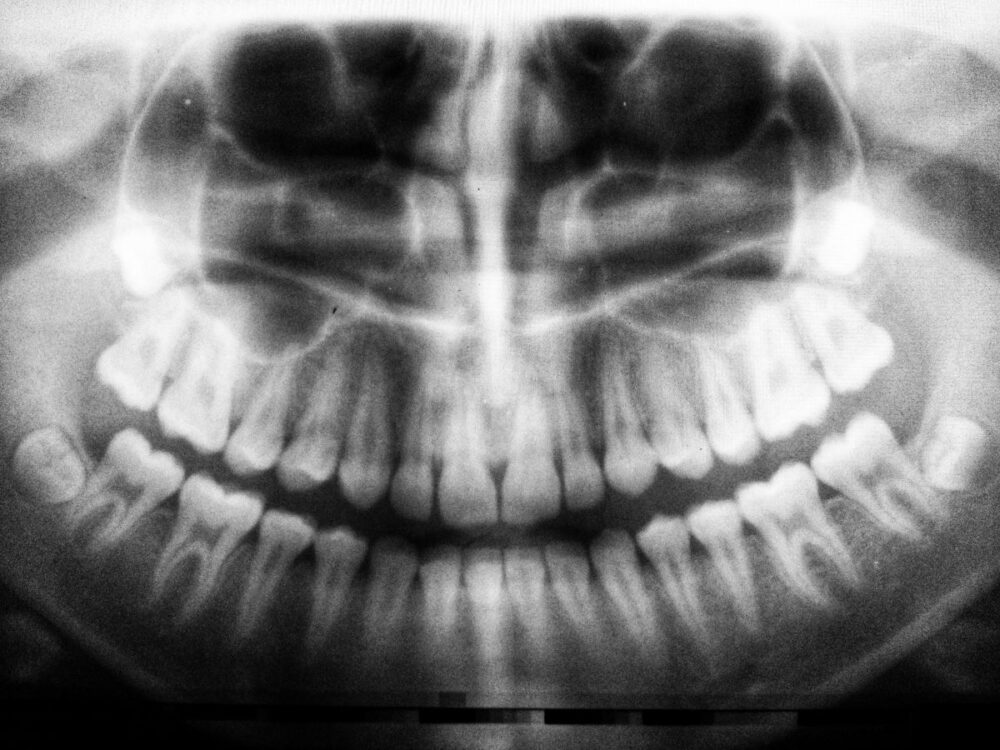
You’re standing at the mirror. Something feels loose. You reach in, and a tooth comes away in your hand. Then another. Then you wake up, run your tongue around your mouth and find everything exactly where you left it.
It’s a horrible way to start the morning, and a very common one. Around 39% of people say they’ve had a teeth dream at least once, with 16% having them repeatedly and 8% having them regularly.
The lowdown: Teeth dreams are usually put down to stress and anxiety. The only study to test that directly found something else. Teeth dreams tracked physical tension in the teeth, gums and jaw on waking, which can be a sign of grinding your teeth in your sleep, and showed no link to psychological distress at all.
The popular answer, the one you’ll find almost everywhere, is that teeth falling out represents anxiety, loss, or a feeling that things are slipping out of your control.
That reading has a very long history behind it. People have been trying to decode this dream for the best part of two thousand years, and they’ve landed all over the place. It’s been taken as a sign you’re about to pay off a debt, a warning that someone in your family is going to die, a coded expression of repressed desire and a plain fear of getting old. Anxiety is simply the version our own century settled on.
The research answer is more physical. When psychologists actually measured it, teeth dreams lined up with tension in the teeth, gums and jaw on waking. They didn’t line up with stress.
Teeth dreams have barely been studied, which is odd given how common they are. The main piece of work is a 2018 study from Ben-Gurion University, published in Frontiers in Psychology. The researchers asked 210 students about their dreams, their psychological symptoms, their sleep quality and whether they woke up with tenderness or tension in their teeth, gums or jaw. Then they looked for connections.
Teeth dreams were linked to that jaw and teeth tension. They were not linked to psychological distress. Not to anxiety, not to depression, not to any of the symptom scales the researchers checked.
The interesting bit is what happened with the other dreams. Dreams of falling and dreams of being smothered were connected to psychological distress. So it wasn’t that the study couldn’t detect stress in dreams. It found stress in other dreams and not in this one.
There are limits to the study. It was 210 students, mostly women, measured at a single point in time, so it can’t prove which causes which. The authors say as much and call for bigger studies. It remains the only direct test anyone has run.
That’s what the same study mentioned above points towards. Tension in the teeth, gums or jaw when you wake up is one of the recognised markers of sleep bruxism, the clinical name for grinding or clenching your teeth overnight. Somewhere between 85% and 90% of people grind their teeth at some point, and around 8.6% do so regularly enough to be considered sleep bruxism.
Here’s the thing about grinding… Most people doing it have no idea. It happens while you’re asleep, and unless someone tells you about the noise, the only clues are a sore jaw in the morning or a dentist spotting the wear. Which is why the researchers made a rather nice suggestion. If teeth dreams really do follow dental tension, then the dream itself might be an early warning of grinding nobody has picked up on yet. Your sleeping brain is taking a sensation in your jaw and turning it into a very memorable image.
If you’re having these dreams often and waking up with an aching jaw, headaches or sensitive teeth, it’s worth mentioning to your dentist.
The symbolic readings have been around far longer than the research. Take them as interpretation rather than evidence:
The most common reading. Losing teeth stands in for losing something you can’t get back, whether that’s a person, a relationship, a job or a version of yourself you’ve outgrown. Grief and endings tend to be where this one lands.
The reading you’ll see most often online, and the one the 2018 study specifically looked for and didn’t find. It’s still worth knowing about, since it clearly resonates with a lot of people. It just doesn’t have evidence behind it in the way the dental explanation does.
Teeth are a fairly primal kind of strength, so losing them makes one a symbol of powerlessness. This reading tends to come up when someone is stuck in a situation they can’t influence, at work or otherwise.
Teeth falling out is one of the more literal images of the body wearing down, making it an obvious stand-in for the fear of ageing. This interpretation was put forward formally by Schneck in 1967 and has stuck around since.
New job, new baby, a move, the end of a relationship. Anything that shifts the ground under you. Jungian thinking leans this way, treating teeth dreams as marking a threshold you’re crossing rather than something going wrong.
If one of those lands for you, that’s genuinely worth sitting with. Dreams don’t have to be scientifically decoded to be useful prompts.
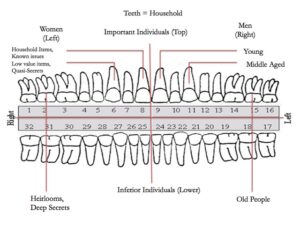
The earliest belief on record belongs to Artemidorus, a professional dream interpreter working in Greece in the second century AD. His book on the subject is the oldest documented attempt to explain this dream that anyone has found. He worked through the mouth tooth by tooth, assigning each one its own meaning as you can see below, and concluded that losing teeth in a dream meant you were about to pay off a debt.
Not long after, the Talmud, the central text of rabbinic Judaism, took a considerably darker view. It read teeth dreams as a warning of loss in the family. That one stuck around for centuries.
Sigmund Freud thought that was nonsense and said so in The Interpretation of Dreams in 1900. Freud was the Austrian neurologist who founded psychoanalysis, and he’s a large part of the reason we treat dreams as coded messages worth decoding at all. His own explanation for teeth dreams involved repressed desire, which was where a good many of his explanations ended up.
Freud noted that people in his own time already suspected that teeth dreams came from physical sensations in the mouth. He thought that explanation was probably true, but far too simple on its own. A hundred and twenty years later, that’s roughly where the evidence has landed.
The dream doesn’t vary enormously, which is part of what makes it so recognisable. Most versions come down to how the teeth go.
Some people lose a single tooth. Others feel them crumble or watch them rot. Plenty describe pulling one out and finding the rest follow. Sometimes the teeth belong to somebody else entirely.
From the research angle, the variations haven’t been studied separately, so nobody can tell you whether crumbling means something different from falling.
People do report this one, usually about a partner, a parent or a child, and it tends to be read as worry about that person rather than about yourself.
Nobody has studied it. The standard research questionnaire only asks whether you’ve dreamed about your own teeth falling out, losing them or rotting, so every prevalence figure and every correlation you’ll see relates to your own teeth. Dreams about someone else’s simply haven’t been measured, which suggests they’re a good deal less common.
Start with the practical. If you’re waking with a sore or tense jaw, see your dentist and mention the dreams. A mouth guard is straightforward to fit and helps stop grinding that damages your teeth.
Then look at what’s happening around bedtime. Our 2026 UK Sleep Survey found that racing thoughts are the single biggest reason British adults sleep badly, at 37%, with stress close behind at 28%. Bad dreams and night terrors keep 13% of us awake. Teeth grinding is closely tied to stress, so anything that winds you down before bed helps address the problem from both ends.
A dream journal helps too, mostly by showing you patterns you’d otherwise forget by breakfast. Note the dream, note what was going on that week, and see what turns up.
And if you’re waking up achy and unrested night after night, the dream might not be the only thing worth looking at. Our guide to sleep hygiene is a good place to start.
No. The idea that teeth dreams foretell a death in the family comes from the Talmud and was widely believed for centuries, but there’s nothing behind it. Freud was dismissive of it as far back as 1900. The dream is common, harmless and almost certainly says more about your jaw than your future.
Spiritual readings vary by tradition, and most centre on change, renewal or moving into a new phase of life. Jungian thinking in particular treats teeth dreams as marking a threshold rather than a threat. These are interpretations rather than findings, so take whichever one is useful to you.
If it comes with a sore jaw, morning headaches, sensitive teeth or worn edges, then yes. Those point to grinding, and a dentist can confirm it and possibly fit a mouth guard.
Not according to the research. The 2018 study measured overall sleep quality and general sleep disturbances alongside the dreams, and teeth dreams showed no relationship with either. People having them weren’t sleeping any worse than anyone else.
Grinding your teeth is often a stress thing, and stress is often a sleep thing: If you’re waking up tense night after night, it might be worth looking at what you’re sleeping on. Browse our mattresses.