
How Much Deep Sleep Do You Need?
6 Min Read |
Last Modified 30 July 2026 First Added 23 April 2019

Deep sleep, also known as slow-wave sleep, is the most restorative stage of your night. It’s when your body repairs tissue, strengthens the immune system and relaxes your muscles. But how much do you actually need, and how do you know if you’re getting enough?
Most experts suggest deep sleep should make up about 20 to 25% of your night. With the recommended seven or more hours a night for adults, that works out at around 1.5 to 2 hours. The amount you get shifts with age and lifestyle, and we’ll get into all of that below.
The lowdown: Deep sleep, also called slow-wave sleep, is the most restorative stage of the night. It’s when your body repairs muscle and tissue, boosts your immune system, and files away memories. Most adults spend about 20 to 25% of the night in it, which works out at roughly 1.5 to 2 hours. You can’t target deep sleep directly. The way to get more is to protect your sleep overall, so aim for seven to nine hours and keep a steady routine.
Deep sleep is a stage of NREM (non-rapid eye movement) sleep, usually the third stage of your sleep cycle. Your body is at its most relaxed, and you won’t wake easily, even from loud noises. If something does rouse you mid-stage, you’ll likely feel groggy and disoriented for a while, a feeling known as sleep inertia.
During deep sleep, you go through some clear physical changes:
Deep sleep happens in longer stretches during the first half of the night, with the longest one soon after you fall asleep. A single stretch can last 45 to 90 minutes, then shortens with each cycle as the night goes on.
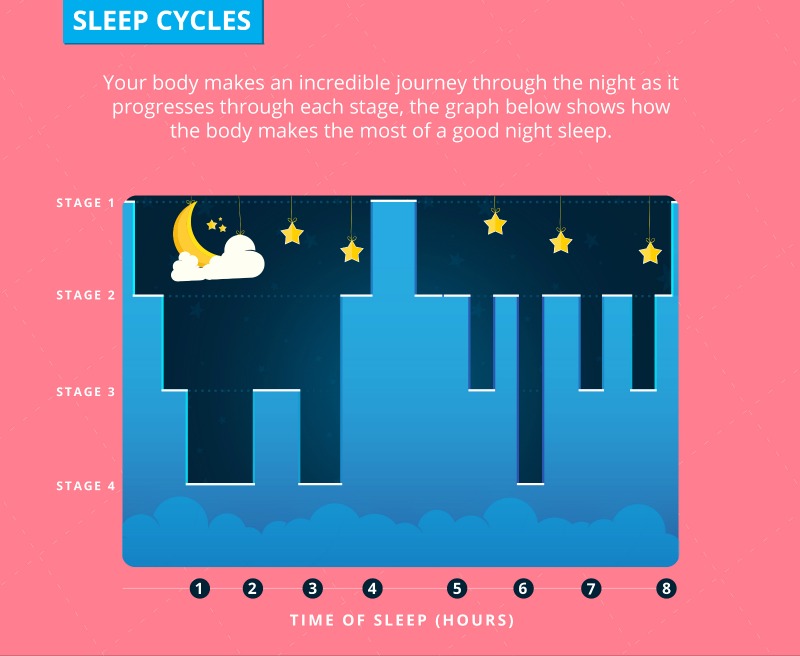
As a rough guide, deep sleep makes up about 20 to 25% of your night, or roughly 1.5 to 2 hours for most adults. Your night overall splits into NREM (around 75%) and REM (around 25%); deep sleep falls within the NREM portion, alongside lighter stages and REM sleep.
There’s no need to fixate on an exact figure. It varies from person to person and night to night. For the bigger picture, see our guide on how many hours of sleep you need.
Deep sleep is the body’s repair shift. It’s when most of your physical recovery and tissue repair happens, when blood flow to your muscles increases and when the pituitary gland releases growth hormone. Your immune system gets a boost, too, which is part of why a run of poor nights can leave you more likely to catch a cold.
It’s not only physical. Deep sleep is when your brain files away the day’s information, helping to turn it into lasting memory. That’s why cramming the night before an exam rarely works without proper rest.
Over the long term, too little deep sleep is linked to health problems. Research has connected low slow-wave sleep with higher blood pressure, and a Washington University study found that adults with less deep sleep had higher levels of a brain protein called tau, which is associated with Alzheimer’s disease. The science is still developing, but it’s another sign of how much this stage earns its keep.

 Verified by Sleep Expert Sammy Margo
"Deep sleep is when the body does its best repair work—building muscle, strengthening the immune system, and consolidating memories. Without enough, you may feel foggy, emotionally drained, or even get sick more often. Over time, chronic deep sleep deprivation can contribute to serious health risks like heart disease and cognitive decline."
The amount of deep sleep you get isn’t fixed for life. Babies, children and teenagers need the most, since deep sleep drives growth and development. From middle age onwards, deep sleep naturally declines, and older adults tend to get noticeably less as total sleep shortens. If you’re older and getting less than you used to, that’s usually a normal part of ageing rather than a sign that something’s wrong.
The easiest way to get a sense of your deep sleep is a wearable, like a smartwatch or fitness band. These use your heart rate and movement to estimate the time you spend in each stage. One thing worth knowing: they estimate rather than measure your sleep stages, so treat the numbers as a guide and follow the trend over time instead of fixating on a single night. Your body gives you clues, too. If you keep waking unrefreshed and dragging through the day, you may not be getting enough.
Plan your night’s sleep: Tell our Sleep Cycle Calculator when you need to wake up, and it will suggest the best times to go to bed, so you wake at the end of a cycle feeling more refreshed. Try the Sleep Cycle Calculator.
There’s no switch for deep sleep, but protecting your sleep as a whole is the way to get more of it. A consistent schedule, a calming wind-down, a cool dark bedroom and going easy on caffeine and late meals all help. A comfortable, supportive mattress makes a difference, too. We’ve pulled the full set of tactics together in our guide on how to get more deep sleep.
Does deep sleep cause nightmares? Not exactly. Nightmares happen during REM, not deep sleep. Deep sleep is, though, when a group of behaviours known as disorders of arousal tend to show up, including sleepwalking, night terrors, bedwetting, and even sleep-eating. These aren’t caused by deep sleep itself. They just happen during it, often linked to stress, tiredness or anxiety.
If any of these are disrupting your nights, it’s worth a chat with your GP. You might also find our tips on calming anxiety for better sleep useful.
Deep sleep quietly does some of the most valuable work of your night, repairing your body and tidying your mind while you’re completely out. You can’t dial it up on demand, but the better your sleep overall, the more of it you’ll get. Small, steady habits are what make the difference.