What is the perfect ratio of bedroom to bed size?
7 min read
Last Modified 14 July 2026 First Added 20 April 2026
Most people think about whether a bed will fit. Fewer think about whether it will feel right. There’s a meaningful difference between the two.
Walk into a room where the bed is too big, and it can feel oppressive, with the walls closing in around it. Walk into one where the bed is too small and something feels off, like a painting hung on a wall that’s twice its size. Proportion is one of the most underrated factors in bedroom design. Here’s how to get it right.
A bed is the most dominant piece of furniture in the room. It sets the visual weight of the space. A bed that’s too large for the room doesn’t just make it harder to move around – it makes the room feel smaller, busier, and harder to relax in. A bed that’s too small can make even a thoughtfully designed bedroom feel unfinished.
This isn’t just about aesthetics. How a room feels affects how well you sleep. A cluttered, cramped space can make it harder to wind down, even when everything else about your sleep routine is right. Getting the proportion right is, in a quiet way, part of getting the sleep environment right.
The most practical way to think about the bedroom-to-bed proportion is the 3:1 rule. For every three parts of the room, one part should be a bed. It sounds simple because it is, and it holds up well as a starting point.
According to the government’s National Described Space Standard, the minimum floor area for a double bedroom is 11.5 m², with a minimum width of 2.75 m for the primary double bedroom. Most UK master bedrooms exceed these minimums – but even working from the standard, once you account for standard furniture like a wardrobe and chest of drawers, the 3:1 rule points clearly towards a king or super king as the proportionally right choice.
A double bed in the same room would likely feel underwhelming. A bed that’s too small for the space can make a room feel just as unbalanced as one that’s too large.
Interior designers and architects have long used the Golden Ratio – 1:1.618 – as a guide to proportions that feel naturally pleasing. Homes & Gardens explains how it shows up across art, architecture, and interior design, and why spaces built around it tend to feel instinctively right.
Applied to a typical bedroom of 3.35 x 2.74 m, a strict Golden Ratio would suggest a bed of around 2.1 x 1.7 m. The width works. The length falls a little short of standard UK bed dimensions. Adjust the ratio slightly to 1:1.45, and the numbers land squarely in king and super king territory, at around 2.3 x 1.9 m. Whether you put much stock in the maths or not, the conclusion is consistent: in an average-sized master bedroom, a larger bed tends to produce better proportions.
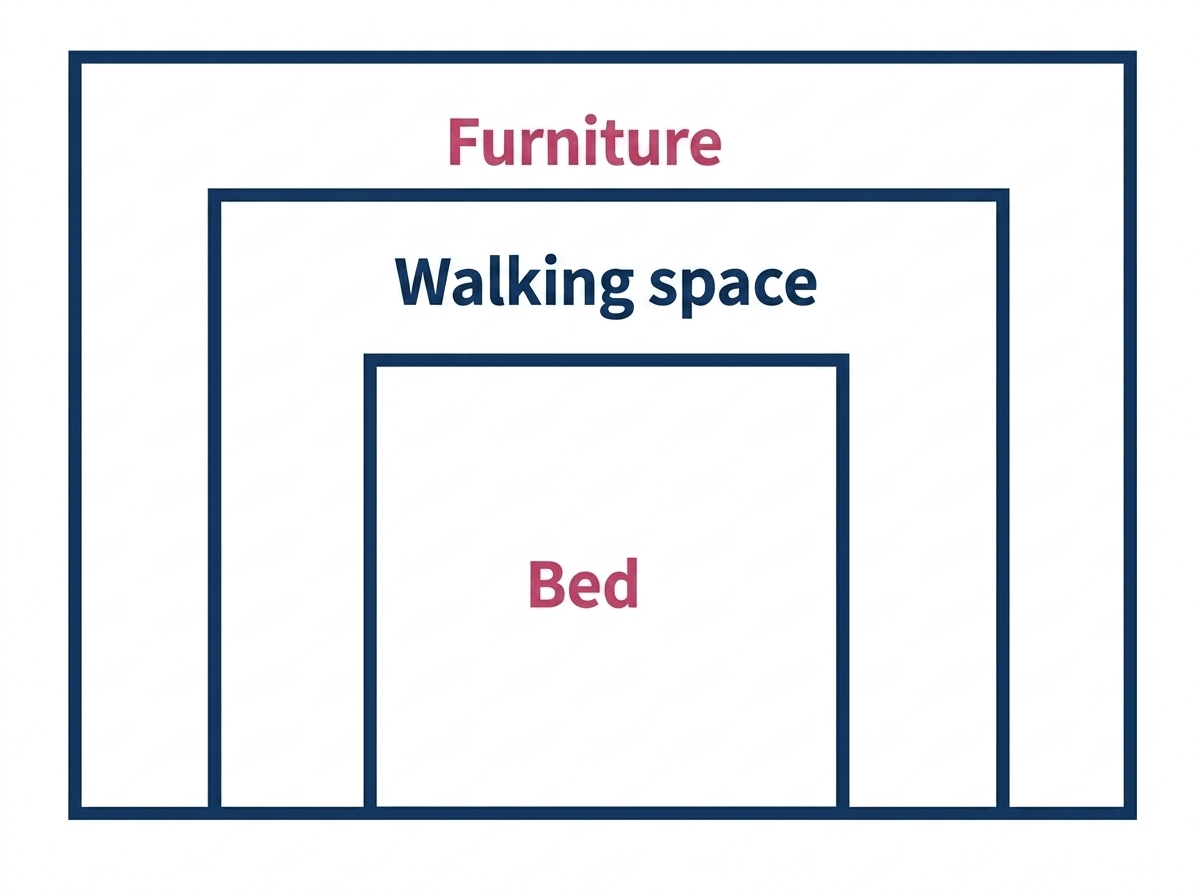
Interior designers also work with the 60-30-10 rule, more commonly applied to colour but just as useful for thinking about space. The idea is that 60% of a room is taken up by furniture and the bed, 30% is circulation and walking space, and 10% is left for everything else.
By this logic, a room that feels right should have generous walking space around the bed rather than furniture pushed to every wall. A bed should account for that 60% when it’s properly scaled to the room. Too small, and the furniture feels sparse. Too large and the 30% circulation space disappears, and with it the sense of ease and calm that a bedroom needs.
The government standard applies only to new builds. Many existing UK homes, particularly older properties, conversions, and flats, have bedrooms that fall below the current minimum. The categories below reflect an estimated range of bedroom sizes found across the UK housing stock.
Small flat or apartment – rooms up to approx. 3.0 × 2.8 m
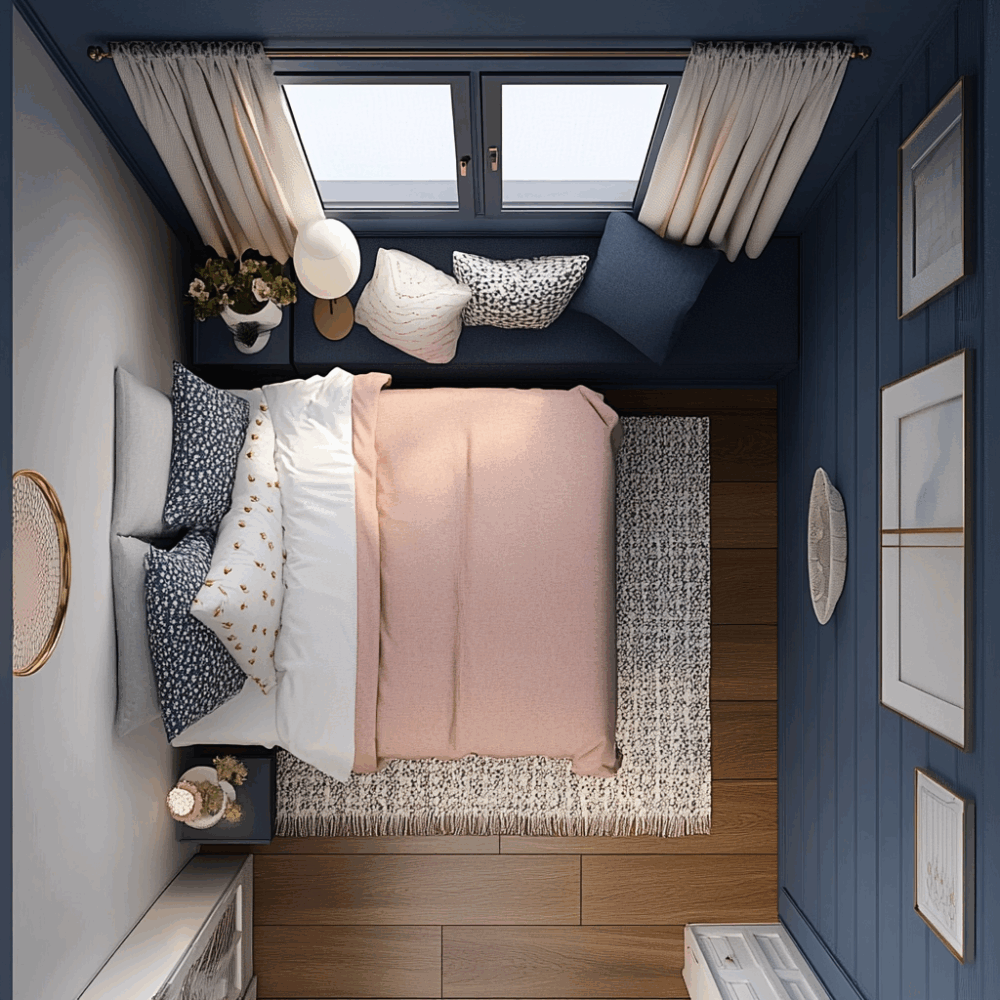
In a smaller bedroom, the temptation is to go as small as possible on the bed to preserve floor space. The 3:1 rule suggests a different approach. A small double (120 cm wide) often hits the proportional sweet spot in a compact room, giving you comfortable sleep space without overwhelming the walls around it.
If you’re sharing the bed, a double (135 cm) may still work – but clear circulation space on three sides matters more here than anywhere else. If storage is also a concern, an ottoman bed keeps the floor clear while giving you serious space underneath.
Average semi-detached – rooms approx. 3.4–4.6 × 2.7–3.4 m
This is the sweet spot where the 3:1 rule is most useful. An average UK master bedroom in a three-bedroom semi comfortably accommodates a king size bed by the proportional logic – and often a super king too, if the room leans towards the larger end of that range.
A double in this space will often look and feel slightly lost. It technically fits, but the room never quite settles. The 3:1 rule and the Golden Ratio both point in the same direction here: go larger than instinct suggests, and the room tends to reward it.
Larger bedroom – rooms over approx. 4.6 × 3.4 m
In a larger bedroom, the risk runs the other way. A standard king can start to feel modest in a room with significant floor space around it. The proportion feels off in the opposite direction – too much empty floor, not enough visual weight from the bed.
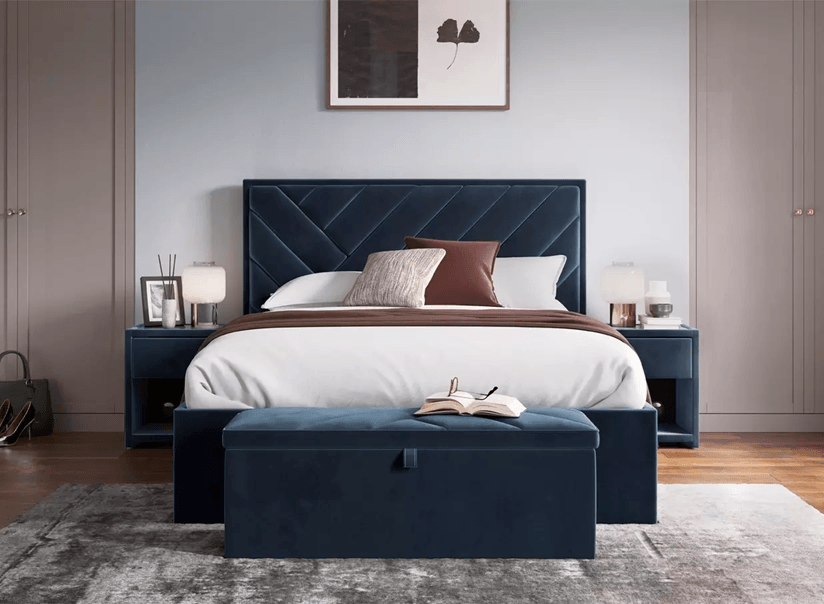
A super king is worth serious consideration here, both for comfort and for proportion. Statement headboards also come into their own in larger rooms, giving the bed the visual presence the space needs. Our bedroom colour wheel and bedroom inspiration section are useful if you’re thinking about how the wider room design can complement the bed.
The rules all point in the same direction. In a room of average UK size, a king or super king bed tends to hit the proportional sweet spot. It fills the visual space without overwhelming it, and leaves enough clear floor to move around comfortably.
For smaller rooms, the logic still applies – just scaled down. A small double in a compact bedroom will often look and feel better than a double that technically fits but leaves no breathing room. Our mattress size guide covers UK standard dimensions if you want to run the numbers on your own room, and our home measuring guide walks through how to map your space properly before you commit.
Whatever size bed you choose, the space around it matters as much as the bed itself. The 3:1 rule and the 60-30-10 rule both implicitly account for this, but it’s worth stating plainly: a bed needs clear space on at least three sides to feel right in a room.
A minimum of around 60 cm on each side gives enough room to walk past comfortably without squeezing. Less than that and the room starts to feel like it’s working against you, even if the bed is a beautiful object in its own right.
If your bedroom is on the smaller side and storage is part of the problem, it’s worth knowing that ottoman beds and divan bed bases can free up floor space elsewhere in the room, which in turn makes the clearance around the bed feel more generous. Our storage beds guide covers the options if you’re weighing it up.
Small but extra cosy – compact bedrooms require a little planning. Allow us to spark your creativity.
10 min read
Feel inspiredIntroducing modern and timeless master bedroom design ideas to easily refresh your space.
6 min read
Feel inspiredShort on space? Let us work our magic to help you make the most of even the snuggest of bedrooms.
9 min read
Feel inspired